

The rapid digital transformation across the subcontinent is reshaping how local businesses function. Modern enterprises are now embracing advanced machine learning to streamline complex operational workflows and improve service delivery models.
This shift represents a significant leap forward for the national economy. By 2026, over 80% of firms will likely adopt these smart models to maintain a competitive edge. Such AI Innovations in Indian Market trends highlight a bright future for technological growth.
We are witnessing a fundamental change in how teams approach daily tasks. By leveraging these tools, companies can foster greater efficiency and unlock new potential. This article explores the most impactful Generative AI Use Cases in India that are currently driving this exciting wave of progress.
Key Takeaways
- Organisations are rapidly adopting smart models to optimise their daily workflows.
- Over 80% of local enterprises plan to integrate these technologies by 2026.
- Enhanced service delivery remains a primary focus for businesses across the region.
- Technological adoption is fostering significant growth and operational efficiency.
- Strategic implementation of these tools helps firms maintain a strong competitive advantage.
The Landscape of Generative AI Use Cases in India
The rapid adoption of Generative AI Use Cases in India is reshaping how local businesses approach innovation and complex problem-solving. Organisations are moving far beyond traditional automation to embrace sophisticated models that mimic human creativity and analytical precision.
This shift is not merely a trend but a fundamental change in how AI-driven technologies in Indian industries are deployed. By integrating these advanced tools, companies are finding new ways to streamline workflows and enhance their overall output.
The economic potential of this transition is staggering. Global projections indicate that the generative AI market will grow at a 47.5% CAGR, climbing from $43.87 billion in 2023 to a massive $667.96 billion by 2030. Indian enterprises are positioning themselves to capture a significant share of this value by adopting these technologies early.
Several factors are driving the successful implementation of these systems across the country:
- Operational Excellence: Companies are using AI to reduce manual errors and speed up decision-making processes.
- Competitive Advantage: Businesses that leverage these tools are consistently outperforming those relying on legacy systems.
- Scalability: Modern AI-driven technologies in Indian industries allow firms to scale their services rapidly to meet growing consumer demand.
As the market continues to mature, the focus remains on solving real-world challenges that require both logic and imagination. The future of Generative AI Use Cases in India looks bright, as more sectors begin to recognise the tangible benefits of intelligent, adaptive software solutions.
Revolutionising Customer Experience with Conversational AI
Conversational AI is fundamentally reshaping how Indian brands engage with their diverse user base. By leveraging Natural Language Processing in Indian Context, companies can now offer support that feels both intuitive and culturally relevant. This technological leap allows businesses to move beyond rigid scripts and embrace fluid, human-like conversations.
Multilingual Chatbots for Diverse Indian Demographics
India’s linguistic landscape presents a unique challenge for digital service providers. To bridge this gap, organisations are deploying advanced chatbots capable of understanding regional dialects and local nuances. Effective communication is no longer limited to English or Hindi alone.
A prime example of this innovation is NoBroker, a leading real estate platform. They utilise their ConvoZen AI to automate customer support across multiple Indian languages. By processing 10,000 hours of recordings daily, the system ensures that users receive accurate assistance in their preferred language.
- 24/7 Availability: Instant responses regardless of the time zone.
- Linguistic Accuracy: Better understanding of regional intent and slang.
- Scalability: Handling thousands of queries simultaneously without human fatigue.
Personalised Shopping Assistants in E-commerce
Beyond simple query resolution, AI is transforming the digital storefront into a bespoke experience. These systems utilise Natural Language Processing in Indian Context to analyse user preferences and past interactions in real-time. This creates a shopping journey that feels uniquely tailored to the individual.
These intelligent assistants act as virtual concierges, guiding customers through complex product catalogues. By actively learning from every interaction, they provide highly relevant recommendations that boost conversion rates. This shift is essential for maintaining customer loyalty in an increasingly competitive digital economy.
Transforming the Indian Healthcare Sector
Modern medicine in India is being redefined by the rapid integration of intelligent digital tools. These advancements are helping medical professionals provide faster and more accurate care to patients across the country. By leveraging data-driven insights, the sector is moving towards a more proactive approach to wellness.
AI-Powered Diagnostic Imaging and Analysis
The implementation of Machine Learning Applications in India is revolutionising how radiologists interpret complex medical imagery. These systems can identify anomalies in X-rays, MRIs, and CT scans with remarkable precision. This technology significantly reduces the time required for diagnosis, allowing doctors to start life-saving treatments much earlier.
By automating routine screening tasks, hospitals can manage higher patient volumes without compromising on quality. These Machine Learning Applications in India ensure that critical cases are prioritised, leading to better clinical outcomes for the population.
Accelerating Drug Discovery through Deep Learning
The pharmaceutical industry is also witnessing a major shift as researchers adopt Deep Learning Solutions in India to streamline the development of new medicines. Traditionally, creating a new drug is a long and expensive process that takes many years. Advanced models now simulate molecular interactions to predict how potential compounds will behave in the human body.
These Deep Learning Solutions in India help companies identify promising candidates while filtering out ineffective ones early on. This efficiency not only lowers the financial burden on firms but also brings essential treatments to the market at a much faster pace.
| Process | Traditional Method | AI-Driven Approach |
|---|---|---|
| Diagnostic Speed | Manual Review | Instant Analysis |
| Drug Discovery | Trial and Error | Predictive Modelling |
| Data Accuracy | Human Dependent | High Precision |
| Cost Efficiency | High Expenditure | Optimised Budget |
Enhancing Financial Services and Banking Operations
The Indian financial sector is currently undergoing a massive digital transformation driven by advanced technology. Financial institutions are increasingly turning to AI Innovations in Indian Market to bolster security and provide tailored financial advice to their clients. This shift is not just about efficiency; it is about creating a more secure and responsive banking environment for everyone.
Research conducted by McKinsey indicates that generative AI has the potential to automate work activities that absorb 60 to 70 per cent of employees’ time today. By offloading these repetitive tasks, human experts can focus on high-value decision-making and complex problem-solving. This transition is helping Indian Companies Using Generative AI to reduce operational costs while significantly improving service delivery.
Automated Fraud Detection and Risk Management
Security remains a top priority for banks operating in a digital-first economy. Modern systems now analyse vast datasets in real-time to identify suspicious patterns that might indicate fraudulent activity. These tools act as a proactive shield, protecting both the institution and the consumer from potential financial loss.
By automating compliance checks, banks can ensure they meet regulatory standards without slowing down the customer experience. This level of precision is essential for maintaining trust in an increasingly complex digital landscape. Real-time monitoring allows for immediate intervention, which is a massive upgrade over traditional manual review processes.
Hyper-Personalised Financial Advisory Services
Beyond security, the focus has shifted towards delivering bespoke financial guidance to individual users. Many Indian Companies Using Generative AI are now deploying intelligent assistants that understand unique spending habits and investment goals. These platforms provide tailored insights that were previously only available to high-net-worth individuals.
The following table highlights the key differences between traditional banking models and those enhanced by modern technology:
| Feature | Traditional Banking | AI-Driven Banking |
|---|---|---|
| Fraud Detection | Manual/Rule-based | Real-time/Predictive |
| Customer Advice | Generic/Standardised | Hyper-Personalised |
| Operational Focus | Administrative Tasks | Strategic Growth |
| Response Time | Delayed/Business Hours | Instant/24-7 |
As these AI Innovations in Indian Market continue to mature, the gap between traditional and modern banking will only widen. Customers can expect more intuitive interfaces and smarter financial tools that simplify their daily lives. This evolution marks a significant milestone in the digitisation of the Indian economy.
Advancing Education and EdTech Solutions
Cutting-edge AI Projects in India are fundamentally changing how students learn and teachers instruct. By integrating smart algorithms into the classroom, the nation is witnessing a shift towards more inclusive and effective pedagogical methods. Indian Companies Using Generative AI are at the forefront of this movement, ensuring that technology serves as a bridge rather than a barrier.
Adaptive Learning Platforms for Students
Modern education is no longer a one-size-fits-all model. Adaptive learning platforms now analyse individual student performance to create bespoke learning paths that cater to specific strengths and weaknesses.
These systems provide real-time feedback, allowing students to master complex concepts at their own pace. Key benefits include:
- Increased engagement through interactive and gamified content.
- Immediate identification of knowledge gaps for targeted support.
- Enhanced accessibility for students in remote or underserved regions.
Automated Content Generation for Educators
Teachers often spend countless hours on administrative tasks, such as drafting lesson plans or creating assessment papers. Fortunately, new tools are helping to reclaim this valuable time, allowing educators to focus more on mentorship and student interaction.
“The integration of generative AI in our curriculum is not about replacing the teacher, but about empowering them with the tools to inspire the next generation more effectively.”
By leveraging Cutting-edge AI Projects in India, schools can now generate high-quality educational materials in seconds. Many Indian Companies Using Generative AI are currently refining these solutions to support multiple regional languages, further democratising access to high-quality resources across the country.
Driving Innovation in the Indian Agricultural Sector
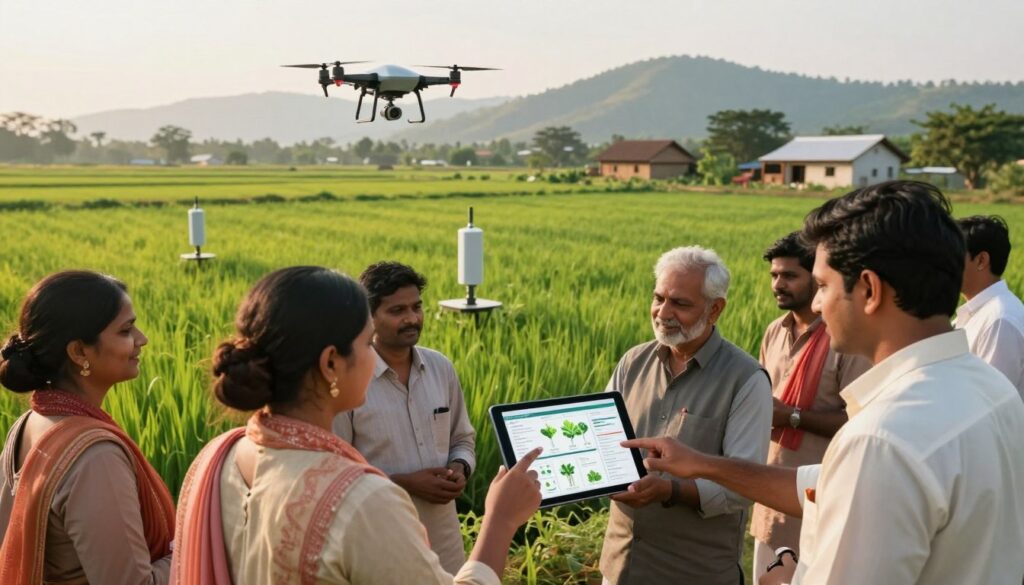
The integration of advanced digital tools is breathing new life into traditional farming across India. As the backbone of the national economy, agriculture is undergoing a significant transformation through the adoption of smart technologies. Machine Learning Applications in India are now essential for modernising farming practices and ensuring long-term food security.
Predictive Crop Management and Yield Optimisation
Farmers are increasingly using predictive analytics to monitor their fields with greater precision. By analysing environmental data, such as soil moisture and weather patterns, these systems help anticipate yield fluctuations before they occur. This proactive approach allows for better resource allocation and reduced waste during the growing season.
Digital supply chain platforms like Moglix have demonstrated how such technology can drive efficiency. By deploying tools like Vertex AI for vendor discovery, organisations have achieved a 4X improvement in sourcing team productivity. These Machine Learning Applications in India prove that data-driven strategies can streamline operations across the entire agricultural value chain.
AI-Driven Advisory Services for Rural Farmers
Access to real-time information is a game-changer for rural communities. AI-driven advisory services provide farmers with actionable insights regarding the best times for planting, fertilising, and harvesting. These tools translate complex data into simple, easy-to-understand advice that helps improve crop quality and overall income.
By bridging the digital divide, these services empower smallholder farmers to make informed decisions based on local conditions. The following table highlights the key differences between traditional methods and AI-enhanced farming approaches:
| Feature | Traditional Farming | AI-Enhanced Farming |
|---|---|---|
| Data Usage | Historical experience | Real-time analytics |
| Decision Making | Intuitive/Manual | Predictive/Automated |
| Resource Use | Fixed/Generalised | Optimised/Targeted |
| Yield Potential | Variable | Maximised |
Modernising Software Development and IT Services
Deep Learning Solutions in India are fundamentally changing how developers write, test, and deploy complex software systems. By integrating these advanced technologies, Indian IT firms are successfully accelerating their development cycles while maintaining high standards of code quality.
Automated Code Generation and Debugging Tools
Modern development teams now rely on intelligent tools to handle repetitive tasks with greater precision. These systems assist developers by suggesting code snippets and identifying potential errors before they become critical issues.
Efficiency is the primary benefit, as engineers spend significantly less time on manual debugging. This shift allows teams to focus their creative energy on high-level architecture and innovative feature design rather than routine maintenance.
“The integration of AI into the software development lifecycle is not just about speed; it is about empowering developers to build more robust and scalable solutions for a global audience.”
Streamlining Legacy System Migration
Many organisations struggle with outdated infrastructure that hinders their digital transformation goals. Fortunately, Deep Learning Solutions in India are being deployed to bridge the gap between legacy systems and modern cloud environments.
These tools enable non-technical staff to interact with siloed data through simple natural language interfaces. This democratisation of data ensures that businesses remain agile and responsive to market changes.
| Feature | Traditional Development | AI-Enhanced Development |
|---|---|---|
| Code Writing | Manual and time-consuming | Automated and predictive |
| Debugging | Reactive and manual | Proactive and intelligent |
| Legacy Access | Restricted to specialists | Natural language queries |
| System Agility | Low | High |
By modernising these core systems, Indian IT service providers maintain their competitive advantage in the global market. This transition is essential for long-term growth and operational excellence.
Creative Industries and Content Creation
From Mumbai’s film studios to digital marketing agencies in Bengaluru, AI-driven Technologies in Indian Industries are becoming a vital partner for creators. These tools allow professionals to produce high-quality content at a fraction of the traditional cost. By automating repetitive tasks, artists can focus more on the creative vision rather than the technical grind.

Generative Media for Advertising and Marketing
Marketing teams across the country are now using cutting-edge AI Projects in India to revolutionise their campaigns. Instead of spending weeks on a single asset, brands can generate thousands of personalised creative variations in just a few hours. This level of speed ensures that advertisements remain relevant to diverse audiences across different regions.
The ability to scale content production is a game-changer for local businesses. By using these smart systems, companies can maintain a consistent brand voice while tailoring messages to specific consumer segments. This shift is effectively turning media houses into low-marginal-cost factories for high-impact digital assets.
AI-Assisted Scriptwriting and Film Production
In the world of cinema, technology is helping writers and directors visualise complex concepts with greater ease. AI-assisted tools act as a sounding board, helping to refine plot structures and dialogue during the early stages of development. This collaborative approach saves time and allows for more experimentation before cameras even start rolling.
Furthermore, cutting-edge AI Projects in India are streamlining post-production workflows, from colour grading to visual effects. These advancements ensure that independent filmmakers can achieve professional results without needing massive budgets. The following table highlights how these modern tools compare to traditional methods in the creative sector.
| Feature | Traditional Method | AI-Enhanced Workflow |
|---|---|---|
| Content Scaling | Manual and slow | Automated and instant |
| Cost Efficiency | High production overheads | Low marginal costs |
| Creative Iteration | Limited by time constraints | Rapid prototyping |
| Personalisation | Broad and generic | Hyper-personalised |
Overcoming Challenges in Indian AI Adoption
Building a sustainable AI ecosystem in India demands a focus on ethics, privacy, and inclusivity. As the Future of AI in India unfolds, stakeholders must navigate a complex landscape of technical and social hurdles. Establishing clear guidelines is essential to foster long-term trust among users and businesses alike.
Data Privacy and Regulatory Compliance
Organisations operating within the country must prioritise robust governance frameworks to manage data risks effectively. With the introduction of new digital protection laws, companies are now required to handle sensitive information with greater transparency. Compliance is no longer optional; it is a fundamental pillar for any successful digital transformation strategy.
By implementing strict internal policies, firms can protect user data while still leveraging the power of machine learning. These frameworks help mitigate legal risks and ensure that innovation does not come at the cost of individual privacy. A proactive approach to regulation will ultimately strengthen the Future of AI in India.
Addressing Linguistic Diversity and Bias
India is home to a vast array of languages, which presents a unique challenge for developers. Implementing Natural Language Processing in Indian Context requires careful consideration of these linguistic nuances to ensure models remain inclusive. If developers ignore regional dialects, they risk creating systems that exclude large portions of the population.
Furthermore, training data must be diverse to prevent algorithmic bias from creeping into automated decision-making. By focusing on inclusive data collection, engineers can build tools that serve every citizen regardless of their mother tongue. Advancing Natural Language Processing in Indian Context is therefore a critical step toward a truly equitable digital society.
| Challenge | Primary Risk | Mitigation Strategy |
|---|---|---|
| Data Privacy | Regulatory non-compliance | Robust governance frameworks |
| Linguistic Diversity | Exclusion of regional users | Multilingual model training |
| Algorithmic Bias | Unfair decision outcomes | Diverse dataset curation |
Conclusion
The rapid evolution of technology is reshaping the way we work and live across the nation. Diverse Generative AI Use Cases in India demonstrate the immense potential for innovation within our local markets. These tools offer unique ways to solve complex problems while boosting productivity for startups and established firms alike.
The Future of AI in India relies on our ability to balance rapid growth with ethical standards. Leaders must focus on data privacy and inclusive design to ensure that every citizen benefits from these advancements. By prioritising responsible implementation, companies can build trust and long-term value.
Continuous learning remains vital for professionals aiming to stay relevant in this changing landscape. The Future of AI in India promises to unlock new economic opportunities for everyone. Exploring these Generative AI Use Cases in India today will help your organisation lead the way in the global digital economy.